
History · Craft
How Roman Dodecahedrons Were Made
Key points
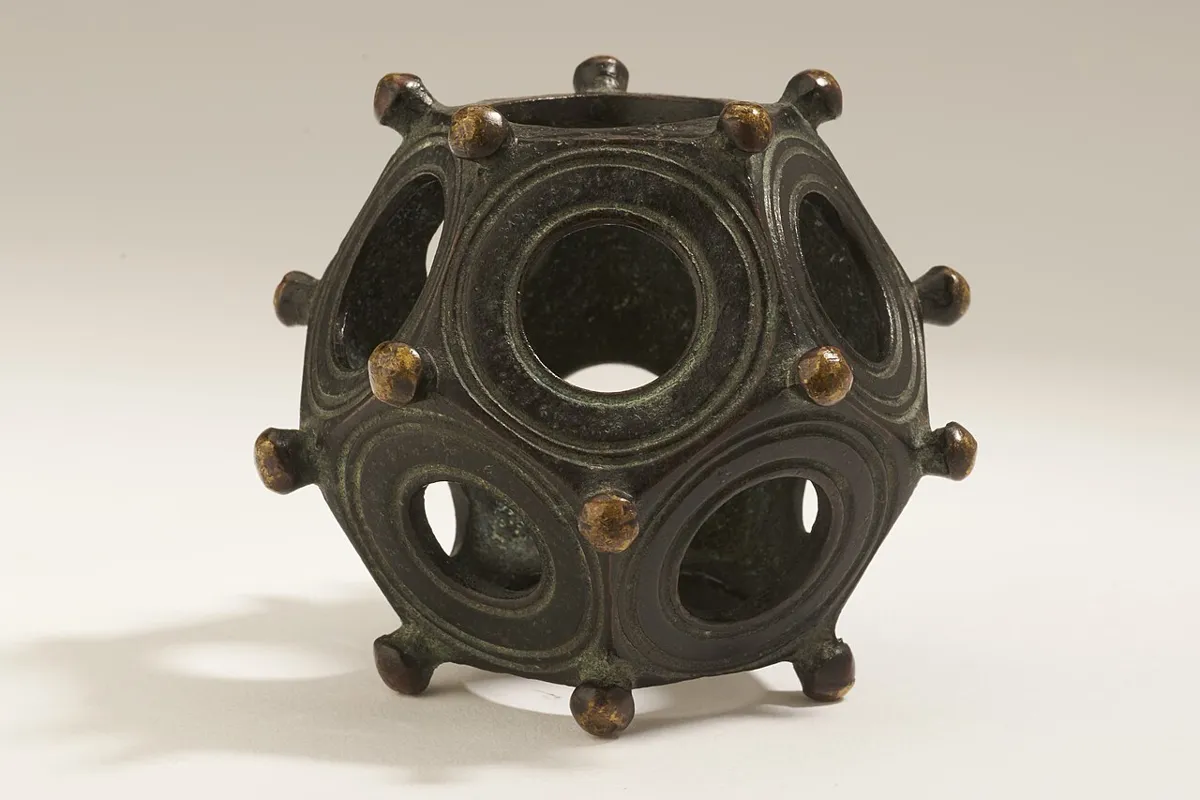
Lost-wax casting
In lost-wax casting a wax model is covered in a mould material, the wax is melted out, and molten metal is poured into the space it leaves. Wikipedia, citing Nouwen (1994), says the dodecahedra were made this way; the Grand Curtius says the same of its Bassenge example.[W][GC]
Clues in the metal
| Feature | Evidence |
|---|---|
| Interior | Left unfinished[W] |
| Exterior | Well finished, probably polished[W] |
| Knobs | Not perfectly regular, so probably made without a mould; generally soldered on[W] |
| One-piece casting | Carmarthen example, Society of Antiquaries of London[W][HILL] |
| Alloy example | Norton Disney: copper 75%, tin 7%, lead 18% (handheld XRF)[TC] |
Why skill matters
The Conversation's Samantha Tipper notes they would have needed a very skilled craftsman and would have been expensive in time and metal.[TC] That is the basis of the theory that they were a bronze caster's masterpiece or test piece.[MF]
A modern experiment
In 2013 the maker behind Atomic Shrimp built a wax dodecahedron from cut sheets, added knobs on stalks, invested it in plaster, dried the mould for weeks, melted out the wax and poured pewter. Two knobs failed to fill and soldering repairs would not take, a reminder of how hard these were to make.[AS]
How our replica is made
Our solid metal dodecahedron replica is lost-wax cast too, in 100% solid brass or solid bronze, with an antique electroplated finish. It is based on the Brian Campbell dodecahedron and scaled to 10 cm.
FAQ
How were Roman dodecahedra made?
By lost-wax casting in copper alloy, with knobs usually soldered on.
What metal were they made of?
Copper alloys. The Norton Disney example tested at about 75% copper, 7% tin and 18% lead.
Sources
- [W] Wikipedia, “Roman dodecahedron” (accessed Oct 2026)
- [GC] Grand Curtius, Liège, “Dodecahedron” (collection page)
- [HILL] C. Hill, “Gallo-Roman dodecahedra: a progress report”, The Antiquaries Journal 74 (1994) (cited by Wikipedia)
- [TC] S. Tipper, “Beautifully crafted Roman dodecahedron discovered in Lincoln – but what were they for?”, The Conversation, 2 May 2024
- [MF] T. Metcalfe, “The Mysterious Bronze Objects That Have Baffled Archaeologists for Centuries”, Mental Floss, 6 Aug 2018
- [AS] Atomic Shrimp, “Making A Replica Roman Dodecahedron”, 2013
Looking for a Roman dodecahedron for sale? See the solid metal edition, in brass or bronze.