History · Hub
What Is a Roman Dodecahedron?
Key points
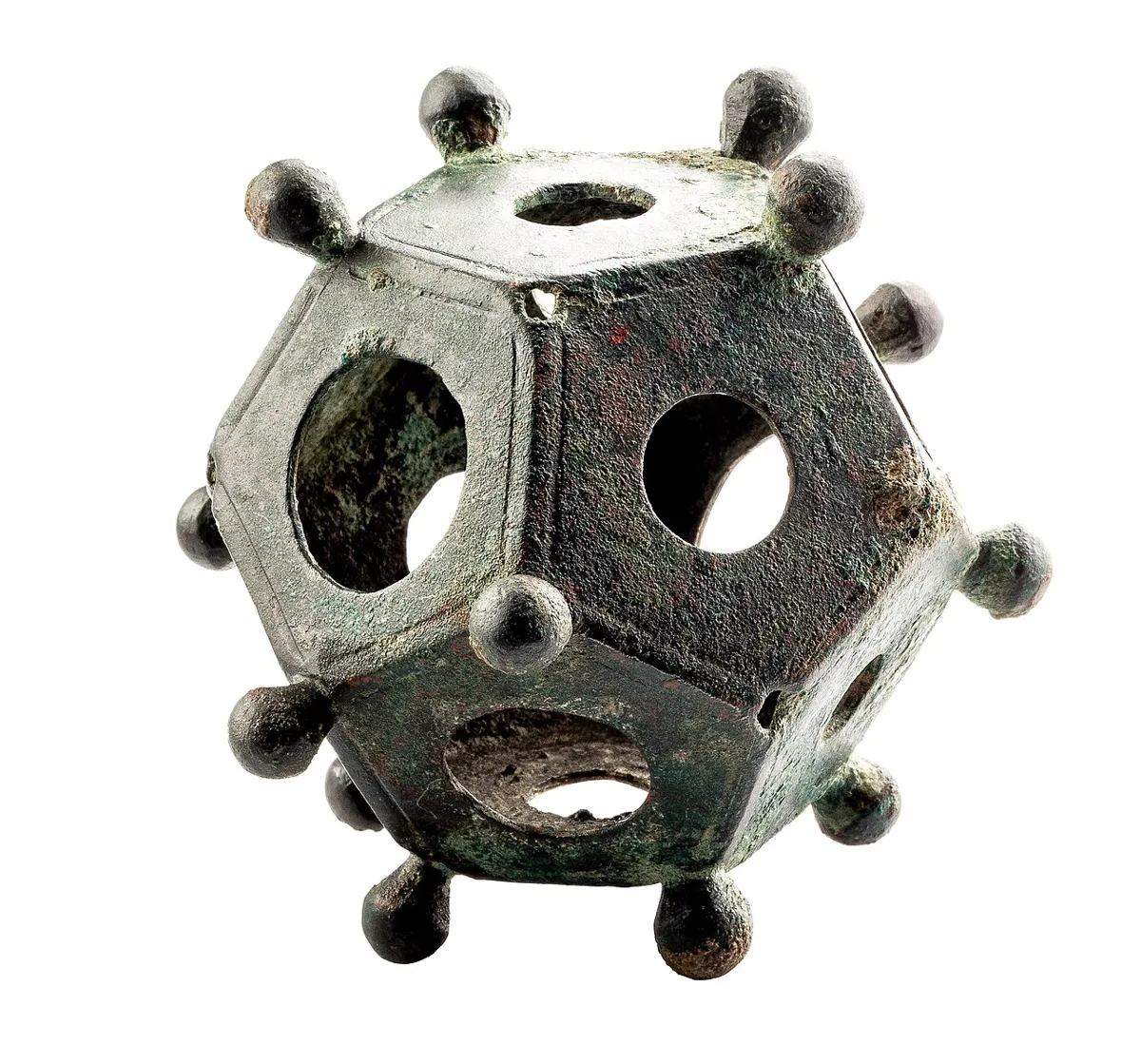
- A small hollow copper-alloy object with 12 pentagonal faces, a round hole in each face and a knob on every corner.[W]
- About 130 are known, from the north-western Roman provinces, dated to the 2nd–4th centuries AD.[W][NCWC]
- No Roman text or picture mentions them. More than fifty explanations have been published; none is proven.[W]
What they look like
Roman dodecahedra are cast in metal, usually a copper alloy, in the shape of a regular dodecahedron with a small ball at each vertex and a circular hole in the centre of each face. The holes differ in size from face to face. Most are decorated with circles, lines and dots, often two or three concentric circles around each hole, but no letters or numbers are known on any of them. They rarely show signs of wear.[W]
Quick facts
| Fact | Detail |
|---|---|
| Date | 2nd–4th centuries AD[W] |
| Number known | About 130[W][NCWC] |
| Size | 4–11 cm across; holes 6–40 mm[W] |
| Weight | 35 g (lightest) to 1 kg (heaviest)[W] |
| Material | Copper alloy, lost-wax cast[W] |
| Where | North-western Roman provinces, mostly Gaul; none in Italy[W][NCWC] |
| First recorded | 1739, Society of Antiquaries of London[W] |
How many, and how old?
The first to be recorded was presented to the Society of Antiquaries of London on 28 June 1739, reportedly from a field at Aston, Hertfordshire. About 130 have been found since, in Austria, Belgium, France, Germany, Hungary, Luxembourg, the Netherlands, Switzerland and the United Kingdom, but not in the Roman heartland of Italy. They were mostly made in Gaul between the 2nd and 4th centuries AD.[W] See where they were found →
Why it is a mystery
No mention of dodecahedra has been found in any contemporary text or picture. Where the find context is known it is commonly military or funerary; others have come from baths, a theatre, a coin hoard and a riverbed.[W]
Theories at a glance
| Theory | Main point for or against |
|---|---|
| Surveying / rangefinding instrument | No markings that a measuring tool would need[W] |
| Spool-knitting tool for gloves | Earliest known spool knitting reference is from 1535[W] |
| Ritual or fortune-telling object | Popular with scholars; links to classical philosophy[W][LS] |
| Coin gauge | Some found in coin hoards[W] |
| Metalsmith's test piece | Based on bronze cost and casting skill[W] |
| Weapon (19th-century idea) | Too light to be effective[W] |
Recent finds
In June 2023 a community dig by the Norton Disney History and Archaeology Group found a complete dodecahedron about a metre below the surface in Lincolnshire. It is one of only 33 found in Roman Britain, measures around 8 cm and weighs 245 g.[NCWC][LCC] Also in 2023, a metal detectorist found a fragment near Kortessem in Flanders, from a dodecahedron that originally measured just over 5 cm across.[LS]
Related objects
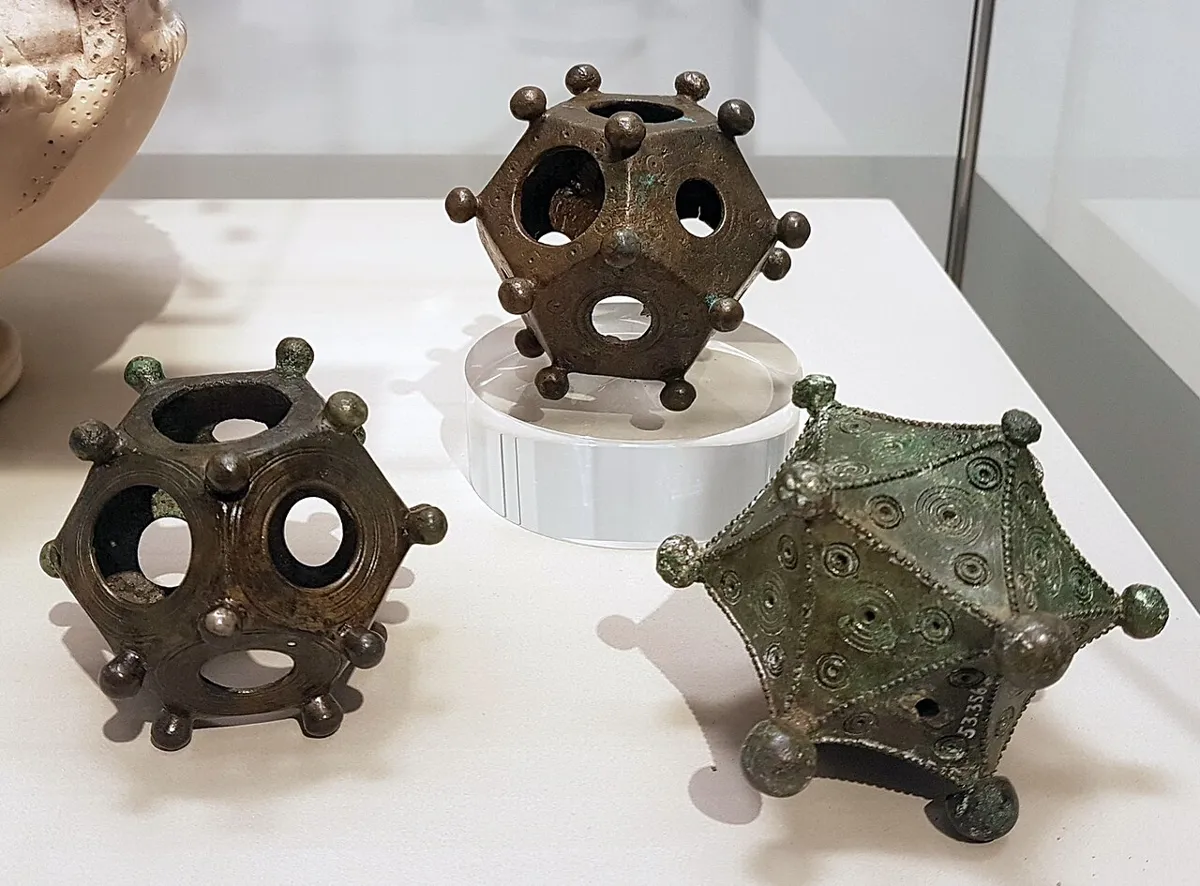
A 20-sided Roman icosahedron from Arloff, Germany, is on display in the Rheinisches Landesmuseum in Bonn.[W] Read about the icosahedron and other relatives →
Where to see one
The Gallo-Roman Museum in Tongeren displays a complete bronze dodecahedron found in 1939,[LS] and the Norton Disney dodecahedron is back at the National Civil War Centre in Newark.[NCWC] Museum guide →
FAQ
What is a Roman dodecahedron?
A small hollow copper-alloy object with twelve pentagonal faces, a round hole in each face and a knob on each corner, made in the Roman north-west in the 2nd–4th centuries AD.
What was it used for?
Nobody knows. More than fifty explanations have been published and none has been proven.
How many have been found?
About 130.
Sources
- [W] Wikipedia, “Roman dodecahedron” (accessed Oct 2026)
- [NCWC] National Civil War Centre, Newark, “Norton Disney Dodecahedron”
- [LCC] Lincolnshire County Council, “Mysterious Roman dodecahedron found in Norton Disney to go on display in Lincolnshire for the first time”
- [LS] T. Metcalfe, “Mysterious 12-sided Roman object found in Belgium may have been used for magical rituals,” Live Science, 26 Jan 2023
- [G13] M. Guggenberger, “The Gallo-Roman Dodecahedron,” The Mathematical Intelligencer 35(4), 2013, pp. 56–60 (cited by Wikipedia)