Guide
Roman Dodecahedron Size, Weight and Materials
Key points
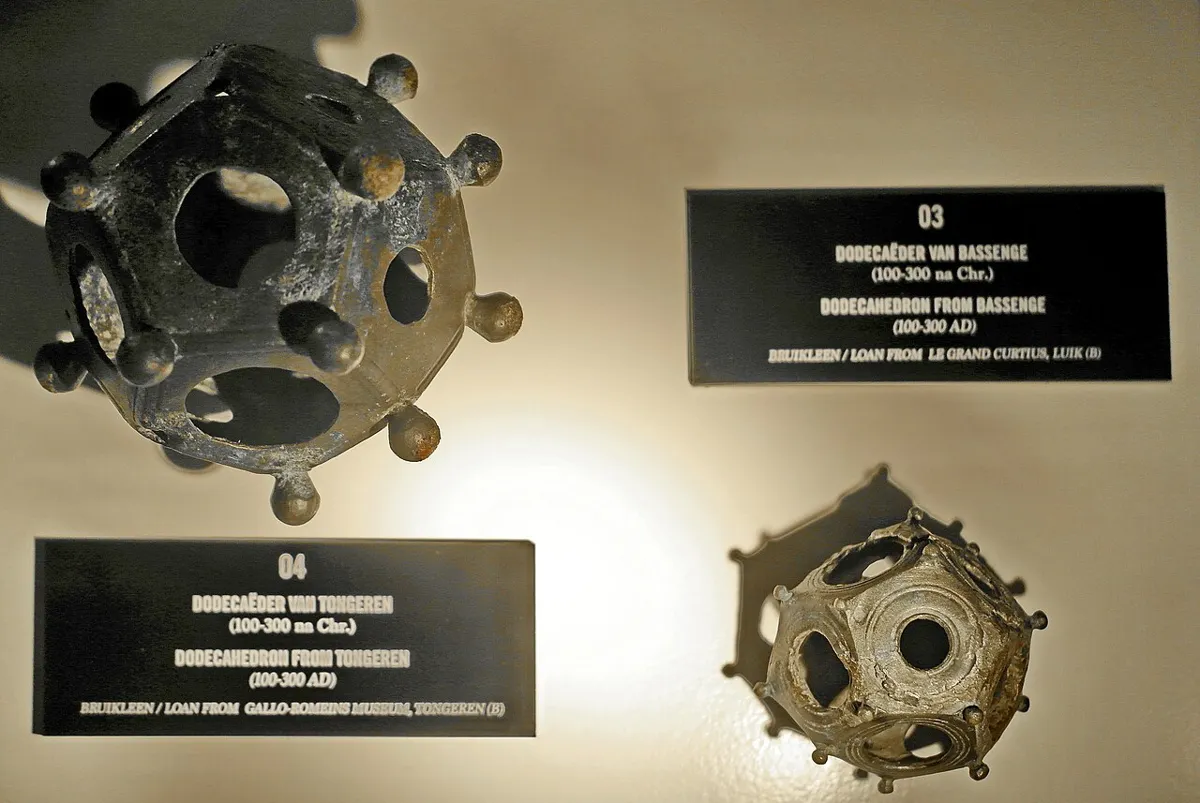
Size and weight range
How they were made
They were cast using the lost-wax technique. The outsides are well finished and were probably polished, while the interiors were left unfinished. The corner balls are not perfectly regular, suggesting they were made without a mould, and are generally soldered on, though the Carmarthen example at the Society of Antiquaries of London was cast in one piece. One London find has clusters of three balls at each corner.[W]
The holes
Each face has a circular hole of a different diameter, connecting to the hollow centre, commonly framed by two or three concentric circles.[W]
FAQ
How big is a Roman dodecahedron?
Between 4 and 11 cm across.
What are they made of?
Copper alloy (bronze), cast by the lost-wax method.
How heavy are they?
From 35 g to 1 kg.
Sources
- [W] Wikipedia, “Roman dodecahedron” (accessed Oct 2026)
- [LCC] Lincolnshire County Council, “Mysterious Roman dodecahedron found in Norton Disney to go on display in Lincolnshire for the first time”
- [LS] T. Metcalfe, “Mysterious 12-sided Roman object found in Belgium may have been used for magical rituals,” Live Science, 26 Jan 2023