
History · Museums
The Bassenge Dodecahedron at the Grand Curtius, Liège
Key points
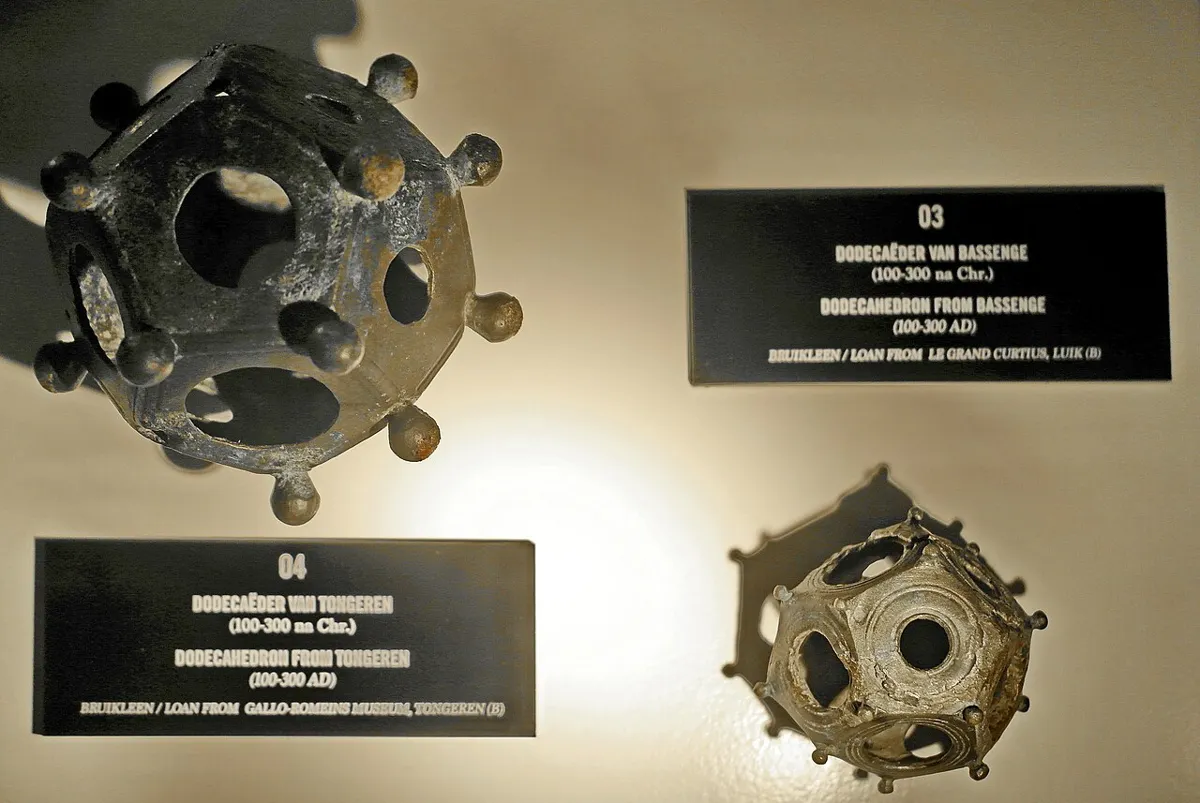
The object
The Grand Curtius describes a hollow, openwork regular dodecahedron, cast by the lost-wax technique, with twelve equal pentagonal faces each pierced by a circular opening of varying diameter. Concentric circles are engraved around ten of the openings, and each corner has a small sphere 3 mm across.[GC] It came from excavations by the Fraikin brothers at Bassenge in 1888 and 1889.[GC2]
Context
The museum's view
The museum lists the common proposals as sceptre heads, candlesticks, calibrators, distance-measuring tools, masterpieces or dice for predicting the future. It finds most enticing the idea of divination games, supported by the Geneva zodiac die of 1982.[GC] It also notes that more than a hundred Gallo-Roman dodecahedra are recorded, mainly north of the Alps, in military camps, theatres, temples, houses and tombs.[GC]
FAQ
Where is the Liège dodecahedron?
In the archaeology collection of the Grand Curtius museum in Liège, Belgium.
Where was it found?
In a grave at Bassenge, excavated in 1888–1889.
How big is it?
4.5 to 4.8 cm high including the corner spheres.
Sources
- [GC] Grand Curtius, Liège, “Dodecahedron” (collection page)
- [GC2] Grand Curtius, Liège, “Un objet mystérieux” (collection page, French)
Want a Gallo-Roman dodecahedron on your desk? Our bronze dodecahedron replica is cast by the lost-wax method.